
Introduction
Teams often believe performance work starts when traffic doubles. In practice, performance reliability starts much earlier: when endpoint contracts are still easy to shape. This tutorial walks through a complete Rails query-shaping process you can apply in production without risky rewrites. The target is not “faster once.” The target is “predictable every release”, especially in p95 and p99 where customer pain is concentrated.
Problem Statement
Most Rails APIs degrade in a familiar pattern:
- p50 looks acceptable.
- p95 drifts during launch campaigns.
- p99 spikes under mixed tenant workloads.
- incident notes repeatedly mention database time and payload size.
This usually happens because query behavior is emergent instead of designed. Associations are loaded by convenience, serializers grow over time, and list/detail endpoints silently share expensive code paths.
Step 1: Define Performance Contracts Before Optimizing
Start by setting explicit budgets per endpoint class:
- list endpoints: strict row and payload limits.
- detail endpoints: broader payload but bounded association depth.
- search/filter endpoints: timeout and fallback behavior.
Write the contract in code comments or architecture notes and keep it close to the query object. If your team cannot explain “what this endpoint is allowed to load,” optimization becomes guesswork.
Step 2: Build a Reproducible Baseline
Use production-like data shape, not just row counts. Two datasets with equal size can behave very differently if one has skewed tenant distribution or high-cardinality associations.
For each test run, collect:
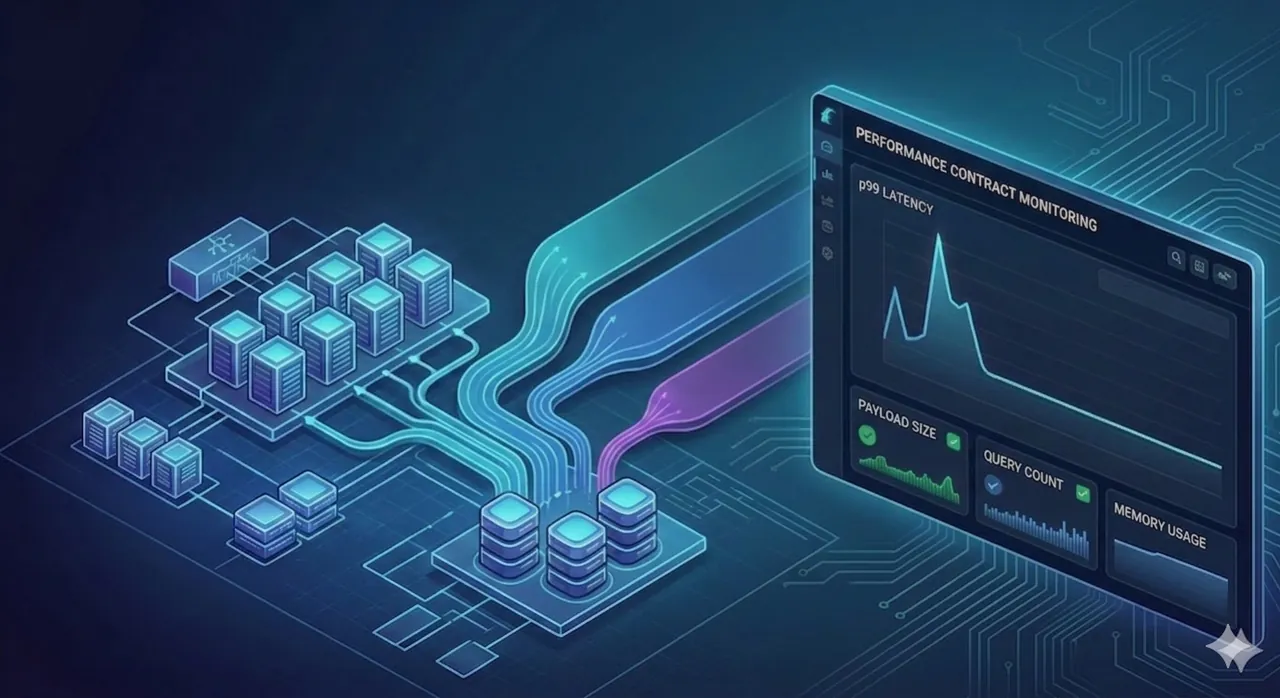
- request latency by percentile (p50, p95, p99),
- database time per request,
- query count,
- payload size,
- memory growth during burst traffic.
Lock these metrics for a baseline window before changing code.
Step 3: Separate Endpoint Responsibilities
A common anti-pattern is using one “convenient” scope for multiple endpoint types. Split query paths by intent:
- index query: minimal fields, strict preload list.
- show query: richer associations, still bounded.
- export/admin query: isolated path, never reused in customer-facing API.
This separation improves both performance and code ownership. Engineers can evolve one path without accidental blast radius.
Step 4: Shape Selects and Associations Intentionally
Query shaping in Rails is mostly about controlled scope:
- use
selectto avoid loading columns not required for response contracts, - prefer explicit
includestrees instead of broad convenience preloads, - avoid nested eager-loading that inflates memory with low-value fields.
If a field is expensive and low-frequency, load it lazily in a separate path rather than bloating the default response.
Step 5: Keep Serializers Honest
Many teams optimize SQL then lose gains in serializer expansion. Add serializer guardrails:
- max nested depth by endpoint category,
- explicit allow-list for included relationships,
- tests that fail when payload size drifts above threshold.
Without payload governance, query tuning results decay quickly.
Step 6: Instrument Query Fingerprints
Percentiles alone do not tell you which query path regressed. Track query fingerprints and cumulative cost:
- top 10 query fingerprints by total time,
- fingerprints with steep growth week-over-week,
- fingerprint count per endpoint action.
This makes performance review concrete. Engineers discuss “this fingerprint grew 38%” instead of “the API feels slower.”
Step 7: Roll Out With Safety Gates
Do not ship query shaping as one large merge. Use staged rollout:
- release behind feature flag for a subset of traffic,
- compare percentile + DB metrics against baseline,
- expand traffic in steps,
- keep rollback criteria explicit.
Example rollback triggers
- p99 increases by more than 15% for 10 minutes,
- DB CPU saturation exceeds safe threshold,
- queue lag rises due to contention side effects.
Step 8: Address Trade-Offs Explicitly
Query shaping introduces structure and discipline, but it also adds artifacts:
- more query objects/scopes to maintain,
- stricter review expectations for endpoint changes,
- need for documentation to prevent accidental drift.
These are healthy costs. They are far cheaper than recurring release-risk incidents and unpredictable scaling spikes.
Real-World Failure Modes
Across teams, we repeatedly see:
- “fixing” N+1 by globally adding
includeseverywhere, - reusing detail serializers in list endpoints,
- adding one more relation per sprint until payload doubles,
- measuring only p50 and calling performance “good enough.”
Each of these choices hides risk until product growth exposes it at the worst moment.
Operational Checklist
- Define endpoint contracts with row and payload budgets.
- Add contract tests for payload shape and size.
- Track p95/p99 as first-class release criteria.
- Monitor query fingerprints by cumulative cost.
- Enforce canary rollout for high-traffic query changes.
- Document rollback thresholds before deployment.
KPI Framework For Ongoing Teams
Weekly
- p95/p99 per endpoint category,
- query count and DB time per request,
- top fingerprint growth deltas.
Monthly
- change-failure rate linked to query changes,
- number of endpoints violating performance contracts,
- incident count where latency was a primary factor.
These KPIs keep performance work aligned to delivery reliability, not one-off tuning.
Conclusion
Rails performance reliability is less about heroic SQL tricks and more about consistent architecture decisions. When query shape becomes part of API design, teams ship faster with fewer surprises. The real win is organizational: product, engineering, and operations share a stable expectation of system behavior under load.
Next Steps
Pick one high-traffic endpoint this week and run the full tutorial cycle:
baseline, contract definition, query-path split, controlled rollout, and post-release review. Once the pattern works once, codify it as team standard and replicate it across critical APIs.
Author
Grzegorz Lisowski