
Why This Matters
LLM-assisted implementation can accelerate delivery, but it also raises variance in code quality. Teams do not fail because they use AI. They fail because they adopt AI speed without deterministic quality boundaries.
Guardrail Model
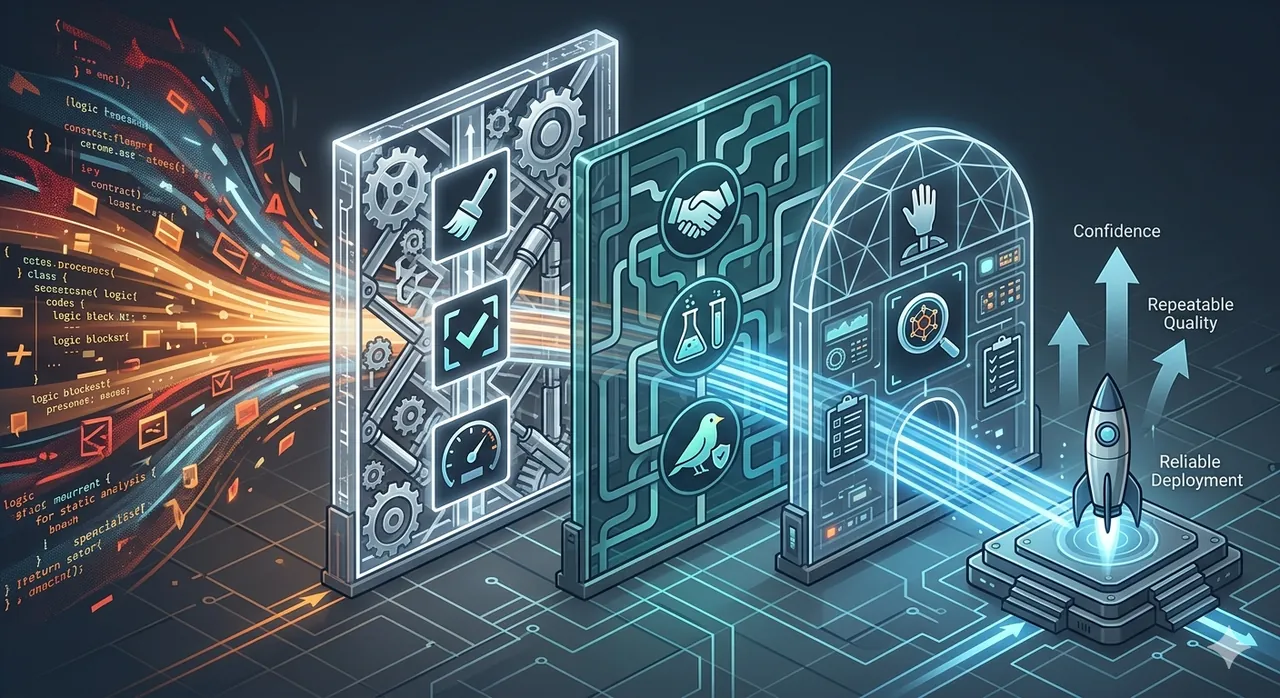
Our model has three layers:
- Structural checks: lint, type checks, schema consistency, and static analyzers.
- Behavioral checks: contract tests, high-risk integration tests, and canary assertions.
- Human decision gates: mandatory senior review for high-impact surfaces.
Risk Classification
We classify generated changes by blast radius:
- Low risk: copy, view-level text, isolated helpers.
- Medium risk: endpoint behavior, query logic, background job flow.
- High risk: auth, billing, data migration, multi-tenant boundaries.
What Worked Best
- Pull-request templates that force intent statements reduced review ambiguity.
- Diff-size thresholds prevented oversized AI-generated patches from bypassing scrutiny.
- Contract-first tests exposed subtle regressions faster than broad e2e suites.
- Canary deployments with explicit rollback triggers lowered incident duration.
Common Failure Modes
The most expensive regressions came from “looks correct” changes in edge-case logic. Deterministic checks caught syntax and structure issues, but business rule drift was caught mainly by domain-aware review and contract tests.
Implementation Guidance
Introduce guardrails incrementally: start with mandatory structural checks and risk labels, then add review policy and canary rollback automation.
Outcome
AI-assisted delivery is reliable when speed is governed by explicit confidence gates. The target is not “more generated code.” The target is predictable quality under faster iteration cycles.
Operational Checklist
- Add risk labels to every AI-assisted pull request.
- Enforce deterministic checks before human review begins.
- Require reviewer sign-off from a domain owner on high-risk changes.
- Define rollback criteria before deployment approval.
KPI Set
- Regression rate per release train.
- Time-to-detect for post-release defects.
- Percentage of AI-assisted changes by risk bucket.
- Rollback frequency for high-impact services.
Governance Model
Treat AI usage policy as an engineering standard, not a suggestion. This includes auditability of prompts/context, change ownership, and decision logs for risky merges.
Common Misconception
Teams often assume “more tests” solves AI risk. In practice, the strongest protection comes from combining deterministic checks, explicit risk classification, and clear release authority.
Adoption Roadmap
Phase 1: structural checks and risk labels.
Phase 2: contract-first testing on critical boundaries.
Phase 3: canary policies and automated rollback triggers.
Phase 4: quarterly guardrail review using production incident data.
End-to-End Implementation Walkthrough
Week 1 - Baseline and taxonomy
Create a shared risk taxonomy for AI-assisted changes. The taxonomy should be concrete enough that two reviewers classify the same PR similarly. Capture examples of low/medium/high risk from your own codebase, not generic templates.
Week 2 - CI gate alignment
Map each risk level to required checks. Low-risk changes may require lint and unit tests only. Medium risk should require contract tests plus smoke integration checks. High risk should require full contract suites, canary deploy eligibility, and domain-owner approval.
Week 3 - Release policy enforcement
Update deployment workflow so high-risk changes cannot bypass canary stage. Add machine-readable metadata to pull requests and deploy artifacts. This gives you traceability when incidents occur.
Week 4 - Audit loop
Run a short review of accepted/rejected AI-assisted changes. Examine false positives (too strict) and false negatives (risky changes that passed). Tune thresholds based on real behavior, not subjective sentiment.
Suggested Toolchain Pattern
- Pre-merge: static checks, type checks, schema guards.
- Merge gate: contract tests + risk-policy validation.
- Pre-deploy: canary eligibility and rollback criteria.
- Post-deploy: telemetry checks and incident tagging.
This layered pattern keeps each tool focused and avoids one huge brittle pipeline.
Review Rubric For Senior Engineers
- Intent clarity: does the PR explain business intent and risk scope?
- Boundary safety: are interfaces and contracts explicitly tested?
- Observability: can regressions be detected quickly in production?
- Rollback confidence: can we revert without data inconsistency?
- Ownership: who is on point if this fails in production?
Common Pitfalls During Adoption
- Teams introduce strict gates without explaining why, causing process resentment.
- Risk labels become “checkboxes” when not tied to deployment behavior.
- Manual review expands but production telemetry remains weak.
- Canary is enabled, but rollback triggers are undefined.
Quality Threshold Recommendations
Start with conservative defaults:
- Require contract tests for every medium/high risk AI-assisted PR.
- Set explicit p95/p99 and error-rate rollback thresholds.
- Limit PR size for high-risk areas to reduce hidden coupling.
- Track post-release regressions by risk class each sprint.
Final Guidance
Successful teams treat AI guardrails as delivery architecture, not compliance overhead. The objective is to preserve speed while making release confidence measurable, reviewable, and repeatable.
Example Policy Pack
Teams moving from ad-hoc AI usage to production readiness benefit from a written policy pack with three documents:
- Risk classification matrix with concrete examples.
- Merge and deploy gate policy linked to CI checks.
- Incident-handling addendum for AI-assisted changes.
Keep these short and versioned with the codebase so policy evolves with architecture.
Change Management Workflow
Proposal
Every substantial AI-assisted change starts with a short proposal: scope, expected value, risk class, and rollback plan.
Validation
Validation depth is selected by risk class, not by team preference. This prevents argument loops in review and keeps quality decisions consistent.
Approval
Approval includes both code correctness and release readiness. “It passes tests” is insufficient for high-risk categories.
Deployment
Canary rollout is mandatory for high-impact paths. Deployment dashboards are reviewed by the same owners who approved the risk class.
Post-release
The first 24 hours are monitored with stricter anomaly thresholds. If alert noise rises, teams run a fast guardrail retrospective.
Security and Compliance Notes
AI-assisted workflows can introduce hidden compliance exposure when prompt/context includes sensitive data. Define explicit guardrails for:
- what context may be shared with tooling,
- how generated code artifacts are reviewed and stored,
- how approvals are audited for regulated domains.
Even non-regulated teams benefit from this discipline because it improves traceability during incident analysis.
Capability Model for Team Maturity
Level 1: Unstructured
AI is used individually with no common risk vocabulary.
Level 2: Guarded
Team introduces minimum deterministic checks and basic review policy.
Level 3: Controlled
Risk classes drive CI, canary, and release decisions.
Level 4: Optimized
Guardrails are continuously tuned from production and incident data.
Level 5: Institutionalized
Guardrails are embedded into onboarding, architecture review, and engineering KPIs.
Teams should assess maturity quarterly and set one realistic capability upgrade per quarter instead of chasing full automation immediately.
Scenario Example: Billing Endpoint Change
Suppose AI suggests a refactor for invoice generation:
- classify as high risk due to financial correctness impact,
- require contract tests for tax rules and rounding behavior,
- canary to low-risk tenant set first,
- predefine rollback if mismatch rate crosses threshold.
This scenario framing keeps teams focused on business risk, not only technical elegance.
Author
Grzegorz Lisowski