
Problem
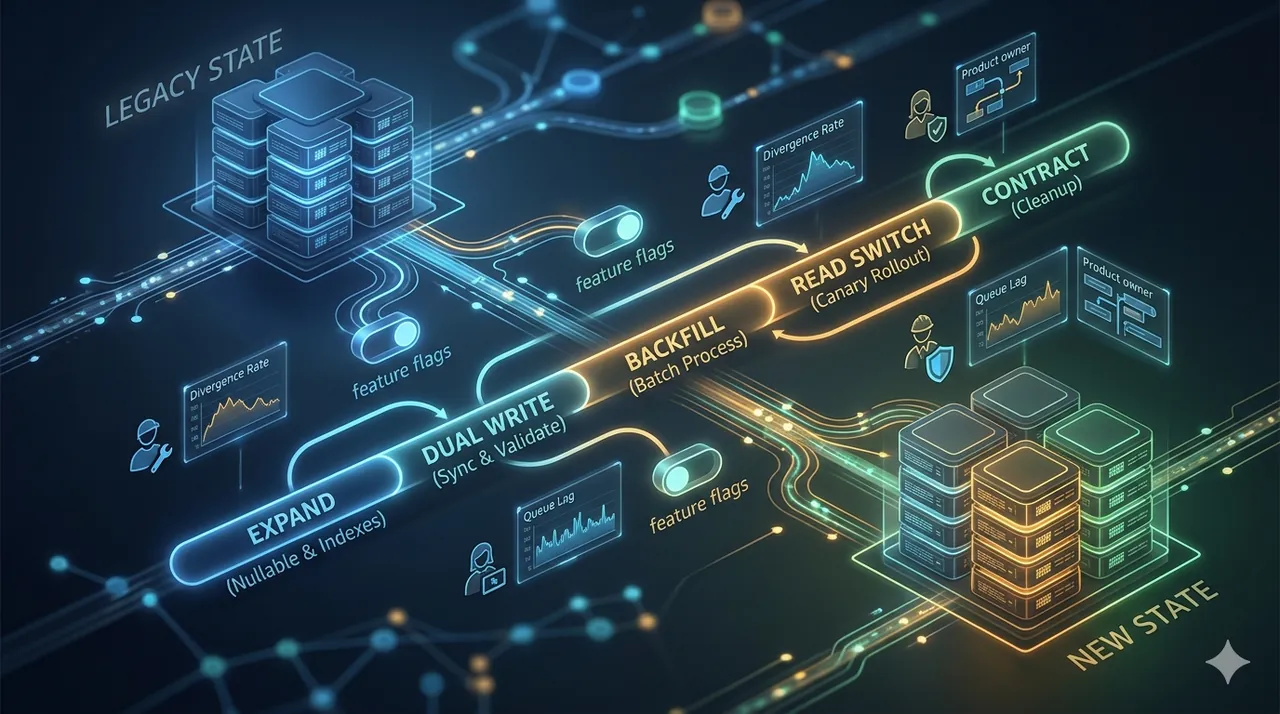
Schema changes fail in production when teams treat migration as a single step. In reality, safe evolution is a sequence: prepare, transition, verify, and only then remove legacy paths.
Safe Rollout Sequence
- Expand: add nullable columns/tables and backward-compatible indexes.
- Dual write: write both old and new representations behind a feature flag.
- Backfill: run idempotent batches with observability on lag/failures.
- Read switch: move reads to the new shape with canary monitoring.
- Contract: remove old fields only after stability window is complete.
Operational Requirements
- Every migration must be reversible or safely pausable.
- Background backfills need bounded batch size and retry policy.
- Metrics must show read/write split and data divergence.
- Release notes must capture dependency order across services.
Trade-Offs
Zero-downtime migration takes longer than direct replacement, but it replaces one big risky event with several small controlled decisions.
Failure Signals
Stop rollout when divergence between old/new read paths exceeds threshold, queue latency spikes, or error rates cluster around switched endpoints.
Team Practice
Use a “migration owner” role per release. Accountability for rollout telemetry dramatically improves response speed when things drift.
Bottom Line
Zero-downtime is mostly release discipline. Rails supports it well when teams model schema change as product delivery, not just database maintenance.
Practical Checklist Before Every Migration
- Define backward-compatibility window.
- Confirm write/read ownership during dual-write period.
- Prepare dashboard for divergence and queue lag.
- Add explicit stop conditions and responsible owner.
Deployment Timeline Example
Release A: expand schema and ship dark code paths.
Release B: enable dual-write and start monitored backfill.
Release C: switch reads with canary verification.
Release D: remove legacy paths after stability window.
Failure Modes To Avoid
- Running unbounded backfills during peak traffic.
- Switching reads without real-time divergence metrics.
- Deleting old columns before rollback window closes.
- Forgetting cross-service dependency order.
Team Communication Pattern
Publish migration briefings to product and support teams. Zero-downtime is technical work, but incident risk affects customer communication and release planning across the organization.
Full Migration Playbook
Planning phase
Start by mapping all code paths touching the target schema. Include write paths, read paths, background jobs, exports, and third-party integrations. Most rollout failures happen when teams map only web requests and forget asynchronous consumers.
Readiness checklist
- Feature flags prepared for dual write and read switch.
- Backfill job idempotency verified.
- Monitoring dashboard published before deployment.
- Rollback owner and escalation chain confirmed.
- Product/support informed of expected timeline.
Backfill strategy in practice
Use bounded batches with sleep intervals to reduce lock pressure. Persist progress markers to allow safe resume after failure. Log per-batch metrics (rows processed, retries, average runtime) and expose them in operations dashboards.
Data consistency validation
During dual-write windows, validate parity between old and new representations. Compare record counts, sampling diffs, and critical aggregates. For business-critical systems, run periodic automated parity checks as part of deployment workflow.
Cutover execution
Switch read paths gradually:
- internal traffic only,
- low-risk tenant segment,
- full rollout with active monitoring.
Keep old writes active for a short confidence window after read switch, then disable them only when parity and stability remain clean.
Incident response plan
Define fast rollback actions before cutover:
- toggle read path flag back to legacy,
- pause backfill workers,
- freeze schema cleanup migrations.
This lowers stress when metrics degrade unexpectedly.
Metrics to track by phase
- Expand: migration runtime and lock wait.
- Dual write: write latency and divergence rate.
- Backfill: throughput, retry ratio, lag.
- Read switch: error rate, p95/p99, parity mismatch count.
- Contract: post-cleanup incident frequency.
Final guidance
Zero-downtime schema evolution is a cross-functional delivery discipline. Treat it as an orchestrated rollout with checkpoints, not a database task hidden in release notes.
Checklist by Team Role
Engineering lead
- confirms migration strategy and rollback envelope,
- signs off on production readiness before cutover.
Backend engineer
- implements dual-write/read-switch safely,
- instruments parity checks and logs.
SRE/operations
- validates alert thresholds and runbooks,
- monitors lock behavior and saturation during rollout.
Product manager
- aligns release windows with risk checkpoints,
- communicates expected user-visible risk envelope.
Support lead
- prepares communication templates for customer-facing incidents.
Realistic Timeline for Medium Systems
Day 1-2: schema expand and deploy dormant read paths.
Day 3-5: enable dual-write for internal segment.
Day 6-10: run measured backfill with lag dashboards.
Day 11-14: canary read switch for low-risk tenants.
Day 15+: full rollout and cleanup planning.
This pacing reduces pressure and improves decision quality.
Decision Gates That Prevent Incidents
Gate A: dual-write divergence below threshold for 48 hours.
Gate B: backfill error ratio below threshold for N batches.
Gate C: read-switch canary has stable p95/p99 and error-rate.
Gate D: rollback drill completed successfully before cleanup.
If any gate fails, pause and remediate;do not “push through.”
Author
Grzegorz Lisowski