
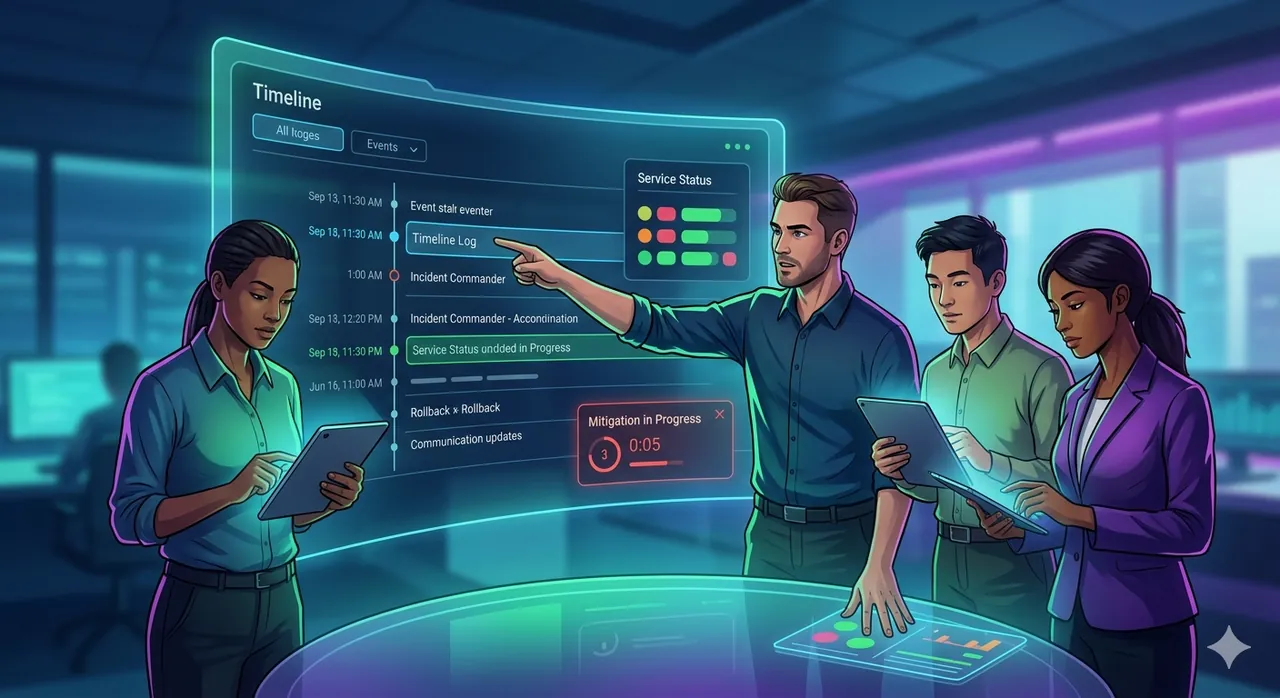
Incident Reality
Most teams do not need enterprise-scale ceremony. They need a repeatable response pattern that protects users and restores service quickly.
First 15 Minutes
- Declare incident severity and assign a single incident commander.
- Stabilize customer impact first: rollback, disable risky features, or apply traffic controls.
- Open one source-of-truth channel for technical and stakeholder updates.
15-45 Minutes
- Split responsibilities: one person drives mitigation, one investigates root path, one handles communication.
- Capture timeline events in real time (what changed, when, and by whom).
- Prefer reversible actions over broad speculative fixes.
45-60 Minutes
- Confirm service recovery with explicit success criteria.
- Publish a short status update with impact, current state, and next checkpoint.
- Define immediate follow-up tasks before closing incident mode.
Post-Incident Loop
Within 24 hours, run a blameless review focused on system improvements:
- Trigger conditions and missing detection.
- Decision points that slowed mitigation.
- Concrete safeguards to prevent recurrence.
Tooling Minimum
You need alert routing, runbook links, rollback mechanism, and a simple timeline log. Advanced tooling helps, but discipline and role clarity drive MTTR improvements first.
Takeaway
Reliability scales when response patterns are lightweight, practiced, and explicit. The best playbook is the one your team can execute under pressure.
Decision Matrix During Incidents
- Rollback when impact is broad and revert path is proven.
- Hotfix when blast radius is narrow and root cause is isolated.
- Feature kill-switch when user protection is immediate priority.
- Traffic shaping when dependency degradation is external.
Metrics That Matter
- Time to mitigation.
- Time to user-impact communication.
- MTTR by incident class.
- Repeat incident rate over 30/90 days.
Practice Cadence
Run lightweight incident drills every month. Teams that rehearse communication and role handoffs reduce confusion dramatically during real events.
Leadership Principle
Clarity beats complexity. A short, shared playbook with clear ownership outperforms detailed but unused documentation.
Full Operational Sequence
Before incidents happen
- Define severity levels with concrete user-impact examples.
- Pre-assign primary and backup incident commanders.
- Store rollback and kill-switch actions in one runbook index.
- Ensure every service has owner-on-call metadata.
During live incident
Minute 0-5
Confirm scope, customer impact, and severity. Freeze non-essential deployments.
Minute 5-20
Execute first mitigation path. Share first external/internal update with known unknowns.
Minute 20-45
Track mitigation effect with explicit metrics. If no improvement window is visible, pivot strategy quickly instead of iterating the same fix.
Minute 45-90
Stabilize service, reduce temporary risk, and assign immediate action items for follow-up.
Communication template
Every update should include:
- impact scope,
- current mitigation status,
- next checkpoint time,
- customer-facing guidance if needed.
This reduces confusion and rumor-driven escalation.
Postmortem framework
A useful review is short and decision-oriented:
- what failed in system design,
- what delayed detection/mitigation,
- what controls will be added,
- who owns each action and by when.
Keep the output tied to execution backlog, not static documentation.
Metrics for maturity
- median time to mitigation by incident type,
- percentage of incidents with first update under 15 minutes,
- recurrence rate of known root causes,
- action-item completion rate within SLA.
Executive reporting guidance
Leadership needs signal, not noise. Provide impact window, confidence level, and prevention commitments. Avoid over-detailed technical logs in executive channels.
Drill Program Blueprint
Monthly drill rhythm
- Week 1: tabletop scenario (communication + command chain).
- Week 2: technical drill (rollback/kill-switch validation).
- Week 3: detection drill (alert quality and triage speed).
- Week 4: improvement review and backlog updates.
This cadence keeps response capability fresh without heavy process overhead.
Priority Scenarios To Rehearse
- Third-party API degradation.
- Database saturation under peak traffic.
- Bad deployment with partial customer impact.
- Queue backlog causing delayed core workflows.
Drill variety matters more than drill complexity.
First-Update Template
Use one short format:
“We are investigating [issue], impact currently affects [scope], mitigation [in progress/completed], next update at [time].”
The template reduces wording delays and keeps stakeholder communication consistent.
Role Handoff Protocol
If incident commander changes during long incidents:
- transfer timeline summary,
- transfer active hypotheses,
- transfer rollback state,
- announce handoff publicly in source-of-truth channel.
This avoids duplicated work and decision drift.
Author
Grzegorz Lisowski