
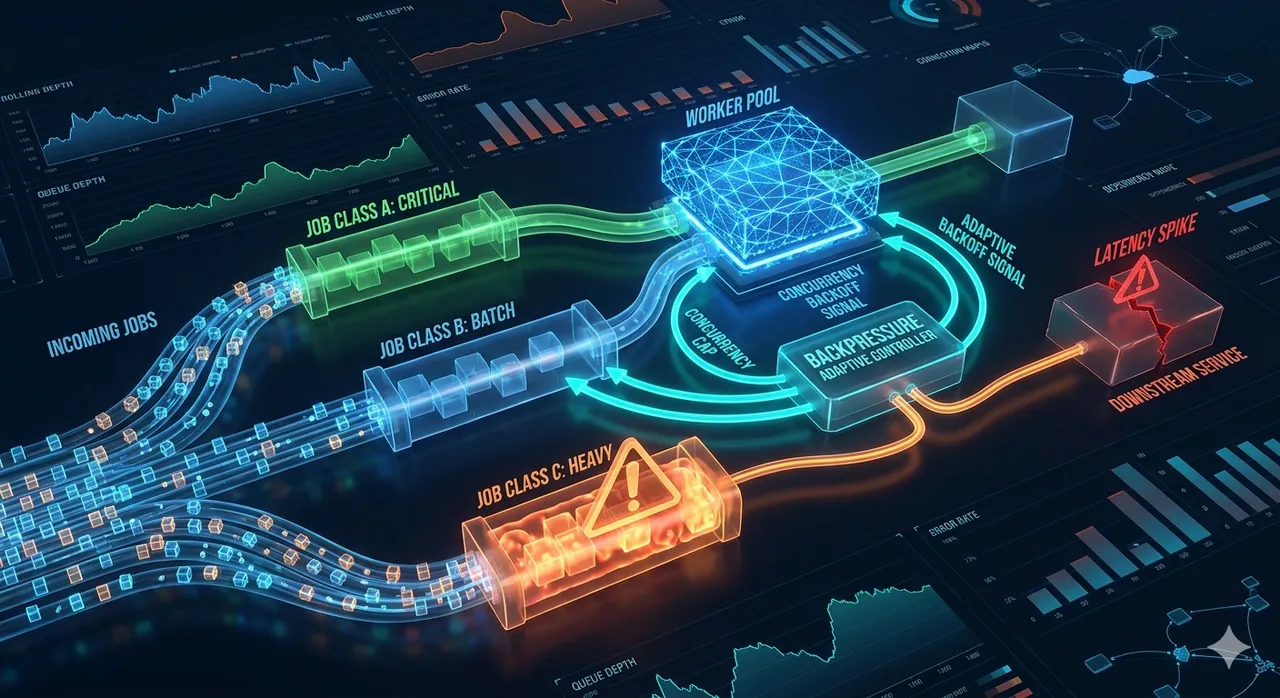
Experiment Goal
We wanted to answer one practical question: which backpressure strategy protects system stability best when job queues spike and downstream dependencies degrade?
Test Design
We simulated burst traffic against worker pools with mixed job cost profiles. The experiment compared:
- naive retries,
- fixed-rate throttling,
- queue-level concurrency caps,
- adaptive backoff driven by error and latency signals.
Evaluation Metrics
- Queue latency and drain time.
- Error amplification across retries.
- Spillover impact on synchronous API endpoints.
- Recovery speed after downstream service normalization.
Key Results
- Naive retries created retry storms and prolonged degradation.
- Fixed-rate throttling improved stability but left throughput underutilized after recovery.
- Concurrency caps reduced blast radius for expensive job classes.
- Adaptive backoff offered the best balance between protection and recovery speed.
Practical Pattern
Use class-based queue isolation plus adaptive backoff thresholds. This keeps critical jobs flowing while containing noisy workloads.
Operational Advice
Pair backpressure logic with visibility: queue depth, retry age, and downstream latency should be first-class dashboards. Without this, teams overcorrect and lose throughput.
Conclusion
Backpressure is a reliability control, not only a scaling tactic. Teams that model failure behavior explicitly recover faster and avoid cross-system incidents.
Implementation Blueprint
- Segment queues by business criticality.
- Apply per-queue concurrency caps.
- Tie retry policy to error class (transient vs deterministic).
- Add adaptive pause logic when downstream latency crosses thresholds.
Production Dashboard Starter Pack
- Queue depth by class.
- Oldest job age.
- Retry volume by worker type.
- Dependency latency and timeout rates.
Rollout Phases
Phase 1: observability and passive thresholds.
Phase 2: enforced caps on non-critical queues.
Phase 3: adaptive backoff with automatic release.
Phase 4: periodic tuning based on incident and load-test data.
Anti-Patterns
- One global retry policy for all job classes.
- Unlimited concurrency for “fast” jobs without dependency protection.
- Backpressure triggers without team-visible telemetry.
Final Recommendation
Treat backpressure policy as part of system architecture reviews. Queue behavior should be designed with failure in mind before peak traffic forces emergency changes.
Experimental Setup Details
Workload profile
We modeled three job classes:
- critical short jobs (user-visible follow-ups),
- medium batch jobs (data sync),
- heavy jobs (reporting/aggregation).
Traffic was injected in bursts to mimic campaign and retry-wave behavior.
Fault model
We simulated partial downstream degradation with elevated latency and intermittent timeouts. This is more realistic than full outage tests and better reflects production instability windows.
Hypotheses tested
- Naive retries maximize throughput only in healthy dependency conditions.
- Fixed throttling reduces incident risk but leaves recovery efficiency on table.
- Adaptive backoff improves resilience when signal quality is good.
Detailed observations
- Retry storms were nonlinear: once queue age crossed a threshold, median recovery time doubled.
- Queue caps were most effective when tuned per job class, not globally.
- Adaptive policies failed when downstream telemetry lagged or was noisy.
- Teams with explicit queue ownership resolved degradation faster.
Implementation guide
- Tag every job class with criticality and max acceptable lag.
- Configure separate retry policies per class.
- Add dynamic pause/resume gates based on dependency health.
- Protect user-critical queues with reserved concurrency.
- Test failover behavior quarterly with synthetic bursts.
Rollback and safety controls
Keep a manual override to disable adaptive logic if signals become unstable. Autonomous controls are useful, but human override protects against telemetry corruption and configuration drift.
Practical thresholds to start with
- Pause non-critical queues when dependency timeout rate exceeds threshold for N minutes.
- Reduce concurrency stepwise when queue age slope rises beyond baseline.
- Resume gradually after stability window, not immediately on first healthy sample.
Long-term governance
Backpressure tuning should be reviewed after every major incident and every major product launch. Queue policy drift is silent and accumulates quickly without regular review.
Practical Experiment Reproduction Guide
Environment preparation
Build a representative staging environment with production-like queue topology, realistic worker concurrency, and synthetic dependencies that can inject latency and timeout behavior. Simplified local tests often hide the true failure profile.
Traffic model
Use repeatable traffic phases:
- baseline steady flow,
- burst window at 3x baseline,
- sustained stress at 1.5x baseline,
- controlled recovery.
Keep this sequence identical for every strategy under test.
Measurement pack
Capture:
- queue depth per class over time,
- age distribution of jobs,
- retries by error category,
- dependency latency/timeout curves,
- user-visible delay for downstream business flows.
This links queue policy quality directly to business outcomes.
Interpretation lens
Evaluate each strategy by:
- stability under burst conditions,
- containment of retry amplification,
- speed of safe recovery,
- operational predictability for on-call teams.
Peak throughput alone is not a production-safety metric.
Author
Grzegorz Lisowski