
Starting Point
The team inherited a legacy Rails system with inconsistent test coverage, unknown runtime bottlenecks, and release anxiety. Business pressure required feature delivery while technical risk remained mostly undocumented.
Objective
Build a first-month audit that produces decisions, not just documentation: what to stabilize now, what to defer, and what to redesign.
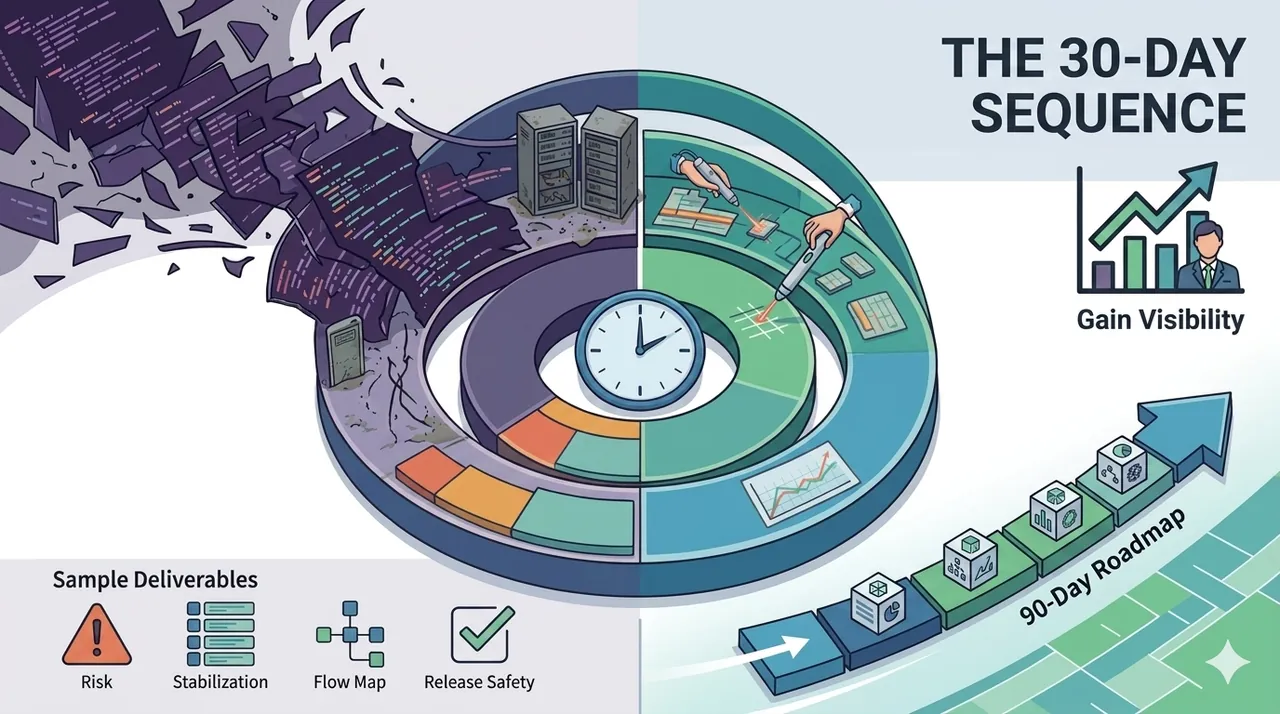
30-Day Sequence
Week 1 - System Mapping
- Identify critical user journeys and revenue-sensitive flows.
- Map integration dependencies and operational ownership.
- Capture top production error classes and latency outliers.
Week 2 - Risk Classification
- Classify risks by impact and reversibility.
- Separate “must-fix before feature work” from “safe to monitor.”
- Define measurable acceptance criteria for stabilization tasks.
Week 3 - Execution Probes
- Run small remediation probes (query reshaping, retry policies, guard tests).
- Measure operational effect before scaling the intervention.
- Convert successful probes into repeatable patterns.
Week 4 - Delivery Roadmap
- Publish a prioritized 90-day roadmap with owners and checkpoints.
- Align product sequencing with technical risk constraints.
- Set review cadence for roadmap adaptation.
Outcomes
The team moved from reactive firefighting to controlled delivery planning. Most importantly, leadership gained visibility into what was risky, what was stable, and what required investment.
What To Reuse
Keep the audit lightweight, metric-driven, and explicitly tied to product decisions. The value comes from decision quality, not report volume.
Sample Deliverables By Day 30
- Risk register ranked by business impact and reversibility.
- Stabilization backlog with owners, estimates, and expected KPI effect.
- Dependency map with high-risk integration points.
- Release safety checklist for ongoing feature delivery.
KPIs To Track After Audit
- Incident frequency and severity trend.
- Change failure rate.
- Lead time for medium-risk releases.
- Percentage of roadmap milestones delivered on schedule.
Common Pitfalls
- Over-documenting without committing to owners and dates.
- Mixing urgent remediation with strategic refactor in one backlog.
- Focusing on code style while production risk remains unresolved.
Practical Advice
Keep executive communication short and decision-oriented. Leadership needs clear options, confidence levels, and consequences of delay.
Expanded Case Timeline
Days 1-3: Entry and risk framing
We interviewed engineering, product, and support stakeholders to capture pain in operational terms, not only technical vocabulary. This quickly exposed mismatch between perceived and actual critical flows.
Days 4-7: Runtime evidence collection
We analyzed logs, incident history, and deployment events to identify unstable boundaries. The key insight was that most outages originated from integration seams, not core domain logic.
Days 8-12: Architecture and ownership mapping
We mapped service/module ownership and identified orphaned areas where no team had clear accountability. These zones correlated strongly with unresolved defects and release delays.
Days 13-18: Quick stabilization interventions
We selected low-risk, high-impact fixes:
- query-path cleanup on top latency endpoints,
- deterministic retries for flaky integrations,
- basic alert quality improvements.
These did not “modernize everything,” but immediately improved release confidence.
Days 19-24: Risk-to-roadmap translation
Instead of generic technical debt labels, each risk was translated into delivery impact: blocked features, expected downtime exposure, or scaling constraints. This changed roadmap conversations from abstract debt to business trade-offs.
Days 25-30: Decision package for leadership
We prepared three scenarios:
- minimal stabilization path,
- balanced path (stability + feature continuity),
- aggressive modernization.
Each scenario included expected outcomes, resource needs, and confidence range.
What made this audit effective
- Evidence-first narrative instead of opinion-first recommendations.
- Clear ownership on every action.
- Measurable success criteria with checkpoint dates.
- Tight link between technical risk and product delivery impact.
Reusable template for other teams
- Collect incident and release evidence.
- Classify risks by business impact and reversibility.
- Run small probes before committing broad refactors.
- Convert findings into scenario-based roadmap options.
- Track outcomes with explicit KPIs for 90 days.
Closing note
A first-month legacy audit should reduce ambiguity, not produce a long report. If decision quality does not improve by day 30, the audit is incomplete regardless of documentation depth.
Adoption Kit for New Teams
Recommended artifacts to prepare before week 1:
- stakeholder map with ownership boundaries,
- incident timeline template,
- risk scoring rubric,
- stabilization backlog template with decision fields.
Starting with templates accelerates alignment and avoids “format debates” during urgent analysis.
Decision Rhythm That Worked
We used a twice-weekly risk review:
- one meeting to validate evidence,
- one meeting to approve actions.
This separation reduced emotional decision-making and improved execution discipline.
How to Prioritize Stabilization Tasks
Apply a simple score:
priority = business impact x failure likelihood x reversibility factor.
Tasks with high impact, high likelihood, and low reversibility should be executed first, even if implementation is uncomfortable.
Stakeholder Communication Pattern
Keep updates concise:
- what changed since last report,
- what risk moved up/down,
- what decision is needed now.
This format maintains executive trust and avoids status-noise fatigue.
Author
Grzegorz Lisowski